A website can look modern, professional, and polished and still fail to bring in new customers.
You may have a clean homepage, attractive images, good branding, and a mobile-friendly layout. But if visitors are not calling, submitting forms, requesting quotes, or buying from you, something is missing.
The problem is often not how your website looks. It is how well the website works.
Good website design should make it easy for visitors to understand what you offer, trust your business, and take the next step. Good website development should support that experience with fast performance, reliable functionality, mobile responsiveness, and a solid technical foundation.
If your website looks fine but is not producing results, there may be several reasons why.
A Good-Looking Website Is Not Necessarily a Good Business Website
There is a difference between a website that looks good and a website that helps a business grow.
A visually attractive website might impress someone for a few seconds. A successful business website needs to do much more. It needs to answer questions, remove uncertainty, guide visitors, build trust, and make taking action simple.
Think about what happens when someone lands on your website for the first time.
They may be asking:
- What does this business do?
- Is this the right company for me?
- Can I trust them?
- How much does it cost?
- Where do I start?
- How do I contact them?
- What makes them different from other options?
If your website does not answer these questions clearly, visitors may leave even if the design looks excellent.
This is where strategy becomes just as important as appearance.
1. Your Homepage Does Not Explain Your Business Quickly Enough
One of the biggest website problems is unclear messaging.
A visitor should not have to scroll through half of your homepage to understand what your company does.
Your main headline, supporting text, and first call to action should communicate the basic value of your business quickly.
For example, instead of a vague headline such as “Building Better Digital Experiences,” a service business may benefit from something much clearer:
“Professional Roofing Services for Homes and Businesses in Boston.”
The second version immediately tells the visitor what the company does and who it serves.
Keep Your Main Message Simple
Your homepage does not need to explain everything at once.
It needs to establish three things quickly:
- What you offer
- Who you help
- What visitors should do next
The rest of the page can provide supporting information, services, benefits, reviews, projects, FAQs, and other details.
Strong website design creates a clear information hierarchy so visitors know where to look and what matters.
2. Your Calls to Action Are Too Weak
A website can have excellent content and still lose potential customers because there is no clear next step.
Visitors should not have to figure out how to contact you.
Buttons such as “Learn More” can be useful in certain situations, but they are not always the best choice for a business trying to generate leads.
Depending on the business, stronger calls to action could include:
- Request a Quote
- Schedule a Consultation
- Get Started
- Book an Appointment
- Contact Our Team
- Request a Free Estimate
The important thing is that the CTA matches what the visitor is ready to do.
Do Not Overload Visitors With CTAs
More buttons do not automatically mean more conversions.
If every section has three different buttons, visitors may become unsure about what action matters most.
A better approach is to establish a primary action and use supporting CTAs where they make sense.
Your website should guide visitors rather than constantly ask them to make decisions.
3. Your Navigation Makes People Work Too Hard
Navigation is easy to overlook because it is always there.
But confusing navigation can quietly hurt your website.
If visitors cannot quickly find your services, pricing, portfolio, contact information, or important company details, they may simply leave.
A professional website should make navigation feel natural.
Your main menu should contain the pages people are most likely to need. Related pages should be grouped logically, and important actions should be easy to find.
Check Your Website From a Visitor’s Perspective
Open your website as if you know nothing about your business.
Can you find the services in a few seconds?
Can you understand where to go if you want a quote?
Can you find contact information without searching through the footer?
Can you easily move from a service page to a contact page?
If the answer is no, your navigation may need attention.
4. Your Website Is Slow
A beautiful website does not help much if visitors have to wait for it to load.
Large images, unnecessary scripts, poorly optimized plugins, excessive animations, and inefficient code can all contribute to poor performance.
Speed is particularly important on mobile devices, where visitors may be using slower connections.
A website development project should consider performance from the beginning rather than treating speed as something to fix at the end.
Look Beyond the Homepage
Your homepage may load reasonably well while service pages, blog posts, product pages, or forms perform poorly.
Check the pages that actually matter to your customers.
If a visitor searches for one of your services, lands on that page, and has to wait several seconds before the content becomes usable, you may lose that visitor before they even see your offer.
Performance improvements can include image optimization, better hosting, caching, reducing unnecessary scripts, improving code, and reviewing plugins and third-party integrations.
5. Your Mobile Website Feels Like an Afterthought
A website can look perfect on a desktop monitor and still provide a frustrating mobile experience.
This happens when layouts are designed primarily for large screens and only adjusted for smaller devices afterward.
Text may become too small. Buttons may be difficult to tap. Images may take up too much space. Navigation may be awkward. Forms may become difficult to complete.
Responsive website design should not simply make a desktop website smaller.
It should create an experience that works naturally on different screen sizes.
Test the Actions That Matter
Do not only check whether your website technically fits on a phone.
Try using it.
Open the menu.
Visit a service page.
Tap the phone number.
Fill out the contact form.
Try to request a quote.
Scroll through the homepage.
If any of these actions feel frustrating, your mobile experience needs attention.
6. Your Content No Longer Matches Your Business
Businesses change.
Services are added. Services are removed. Locations change. Teams grow. New projects are completed. Industries change. Contact information gets updated.
But websites often stay the same for years.
This can create a gap between what your business actually offers and what your website says you offer.
Outdated content can also make visitors question whether your company is active.
Look for Outdated Information
Review your website and check:
- Old service descriptions
- Outdated team information
- Incorrect contact details
- Old addresses
- Expired promotions
- Outdated portfolio projects
- Old statistics
- Broken links
- Outdated FAQs
- Missing services
Your website should reflect the business customers can actually work with today.
7. Your Website Does Not Build Enough Trust
People rarely choose a business based only on what it says about itself.
They want evidence.
That evidence might include reviews, case studies, project photos, certifications, experience, client results, recognizable partners, or detailed service information.
A website that says “We provide high-quality services” is making a claim.
Showing real projects, explaining your process, and demonstrating experience gives visitors a reason to believe it.
Use Real Proof Whenever Possible
Trust-building content does not need to be complicated.
Depending on your business, you could include:
- Real project photography
- Customer reviews
- Case studies
- Before-and-after examples
- Certifications
- Industry experience
- Service guarantees
- Frequently asked questions
- Clear company information
The goal is to reduce the uncertainty that prevents someone from contacting you.
8. Your Website Was Built for You, Not Your Customers
This is one of the most common problems with business websites.
Business owners naturally want to talk about their company, their history, their services, and their achievements.
Those things matter.
But visitors are usually more interested in what the business can do for them.
Instead of only saying:
“We have been serving customers for 15 years.”
Explain what that experience means for the customer.
For example:
“With 15 years of industry experience, our team knows how to handle complex projects while keeping communication clear from start to finish.”
The difference is small, but the second version connects experience to customer value.
A good website keeps the visitor’s needs at the center of the experience.
Do You Need a Website Redesign or Just a Few Improvements?
Not every underperforming website needs to be completely rebuilt.
Sometimes the problem can be solved with targeted improvements.
Other times, the website has deeper structural problems that make a redesign the better option.
When Small Improvements May Be Enough
You may not need a complete website redesign if:
- The structure is already clear
- The website works well on mobile
- Your technology is reliable
- The branding still fits your business
- Your pages are easy to navigate
- Only content or CTA placement needs improvement
- Performance issues can be fixed without rebuilding the site
In these situations, improving specific pages, content, forms, calls to action, or performance may be enough.
When a Website Redesign Makes More Sense
A redesign may be worthwhile when:
- The website looks noticeably outdated
- The navigation is confusing
- The mobile experience is poor
- The content structure is difficult to manage
- The website is slow
- Important pages are missing
- The design no longer represents your brand
- The site is difficult to update
- Your current website cannot support new functionality
- Your business has changed significantly
A redesign is not simply about giving your website a new look.
The goal should be to improve the entire experience.
When WordPress Services Can Make a Difference
WordPress gives businesses a flexible foundation for building and managing websites, but simply using WordPress does not automatically make a website effective.
The platform still needs to be configured, maintained, optimized, and developed properly.
Professional WordPress services can address everything from design and development to performance, security, content management, SEO, and ongoing maintenance.
A Strong WordPress Website Needs More Than a Theme
Themes and plugins can make it possible to launch a website quickly.
But adding more plugins or changing a theme does not necessarily solve underlying problems.
A professional approach considers:
- Website structure
- User experience
- Page speed
- Mobile responsiveness
- Plugin quality
- Security
- Search engine optimization
- Forms and integrations
- Content management
- Conversion paths
- Future scalability
The result should be a website that is easier to use for customers and easier to manage for the business.
Website Development Is More Than Building Pages
Website development is sometimes treated as a technical task that starts after the design is finished.
In reality, development has a major impact on the customer experience.
Poor development can lead to slow pages, broken functionality, difficult content management, inconsistent layouts, and technical limitations.
Good development creates the foundation that allows the design to work properly.
Build With the Future in Mind
Your website may start with five or ten pages.
A year later, you may want to add new services, locations, landing pages, blog content, integrations, booking systems, or e-commerce functionality.
Your website development approach should make future growth easier rather than forcing you to rebuild everything again.
This is particularly important for businesses that expect their website to become a meaningful source of leads and sales.
Start With the Customer Journey
Before changing your website, think about what you want a visitor to do.
For example:
Search → Service Page → Trust Content → Contact Form → Inquiry
Or:
Homepage → Service → Portfolio → About → Consultation
Every business will have a different customer journey.
The important thing is that your website supports it.
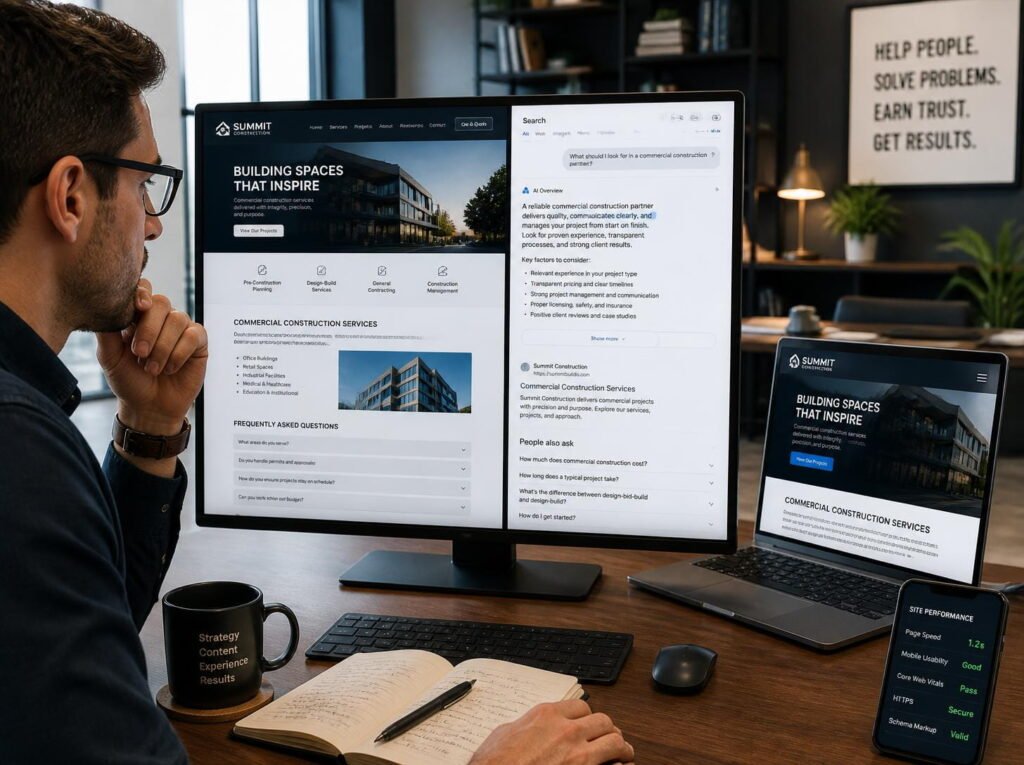
If a visitor arrives on a service page from Google, they should be able to understand the service, see why they should trust you, and find an obvious next step.
If that path is unclear, even strong search traffic may produce disappointing results.
A Website Should Improve With Your Business
Your website should not be something you build once and forget.
As your business grows, your website should grow with it.
New services may need dedicated pages. Successful projects can become case studies. Customer questions can become FAQ content. Search data can reveal opportunities for new pages. Performance reports can highlight technical improvements.
Regular website maintenance helps keep everything working properly while ongoing improvements keep the site useful and competitive.
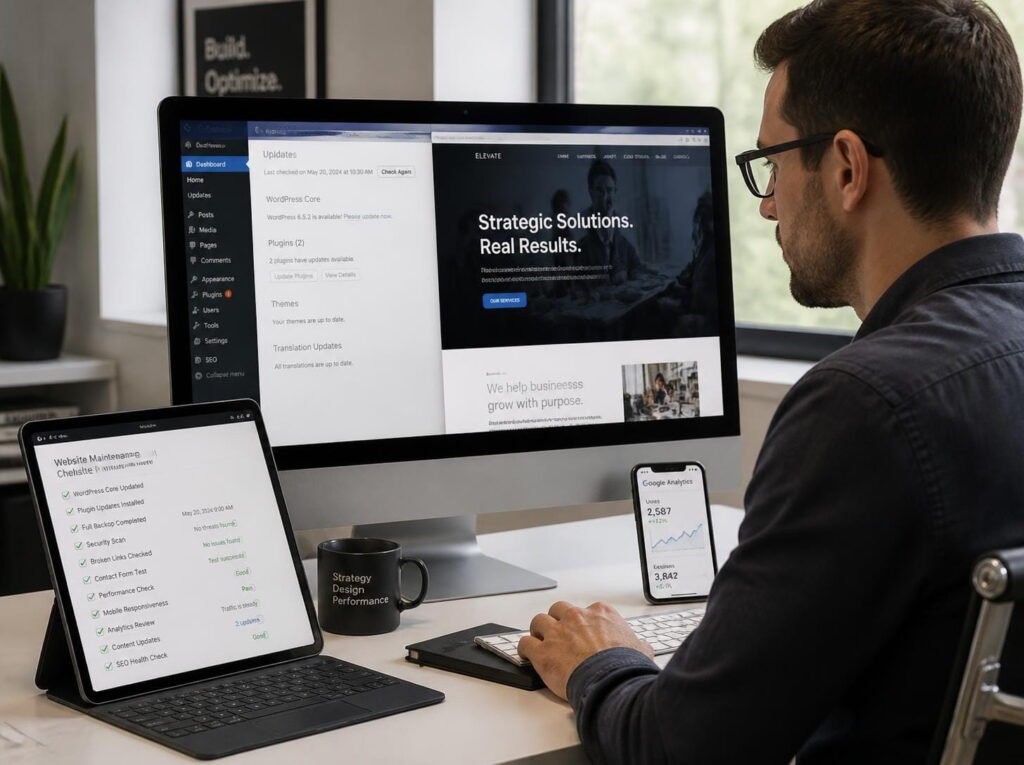
Website Maintenance Is More Than Updating Plugins
Regular maintenance can include:
- WordPress updates
- Plugin and theme updates
- Security checks
- Backups
- Broken-link checks
- Form testing
- Performance monitoring
- Mobile testing
- Technical SEO checks
- Content updates
- Analytics review
A website that works today should continue working tomorrow.
Your Website Does Not Need More Decoration. It Needs a Job.
If your website already looks good, the answer may not be another visual redesign.
The better question is:
What is the website supposed to accomplish?
Is it supposed to generate phone calls?
Get quote requests?
Book consultations?
Sell products?
Build trust?
Generate organic traffic?
Educate potential customers?
Once you know the job, you can evaluate whether the website is actually doing it.
Sometimes the solution is better website design.
Sometimes it is a website redesign.
Sometimes the problem is technical and requires professional website development.
And sometimes the best solution is ongoing WordPress services that keep the website fast, secure, updated, and effective.
The goal is not to create a website that simply looks impressive.
The goal is to create a website that helps your business.
Ready to Improve Your Website?
If your website looks good but is not generating the results you expect, it may be time to look beyond the visuals.
A strong website should make it easier for the right people to understand your business, trust your services, and take action.
Whether you need better website design, a complete website redesign, professional website development, or reliable WordPress services, the first step is understanding what is holding your current website back.
Contact WebFlie to discuss your website: Contact Us